
Conveyor pulley selection
Conveyor Pulley Selection: Position, Interfaces and Lagging
A conveyor pulley can have the right diameter and still be the wrong replacement. The shaft may not fit the existing bearings, the drive connection may differ, or the quoted diameter may leave out the lagging. Start with three separate decisions: what the pulley does, what it connects to and what surface it needs.
This guide covers pulley assemblies for bulk-material belt conveyors. It does not cover motorized drums with a motor inside the shell. For the available manufacturing scope, see our conveyor pulleys and drums page.
Separate the job from the construction
“Rubber-lagged drive pulley” describes a job and a surface. It does not tell a supplier how the shaft, hubs and end discs are connected. Keep those choices separate when comparing drawings or quotations.
| Decision | What to identify | What it does not settle |
|---|---|---|
| Position and job | Drive, tail, bend or take-up; show the location on the conveyor layout. | Shaft geometry, connection design or surface specification. |
| Construction and interfaces | Shell, end discs, hubs, shaft and their connections; parts that must mate with the new pulley. | Which coating or lagging is suitable for the operating conditions. |
| Surface | Bare steel, coating or a specified lagging system, with the finished dimensions. | Whether the complete assembly fits or carries the required load. |
- Drive
- Transfers drive torque to the belt. Identify the drive connection as well as the pulley location.
- Tail
- Turns the belt around at the tail end. Check whether its bearings or take-up supports are being retained.
- Bend
- Changes the belt path. The belt approach and departure directions help define the loading arrangement.
- Take-up
- Works in the tensioning arrangement. Include the support layout and available movement.
These names describe functions, not four interchangeable constructions. A tail pulley can also be part of a take-up arrangement. If the name is uncertain, mark the pulley on a layout. If you need the smaller rollers supporting the belt along its run, use the rollers and idlers page.
Check the parts that must fit the replacement
For a replacement, first decide which parts will stay on the conveyor. Existing bearings, housings, couplings and supports set interfaces that the new assembly must match. A photograph helps identify them; the controlling dimensions still need a drawing or a verified measurement record.
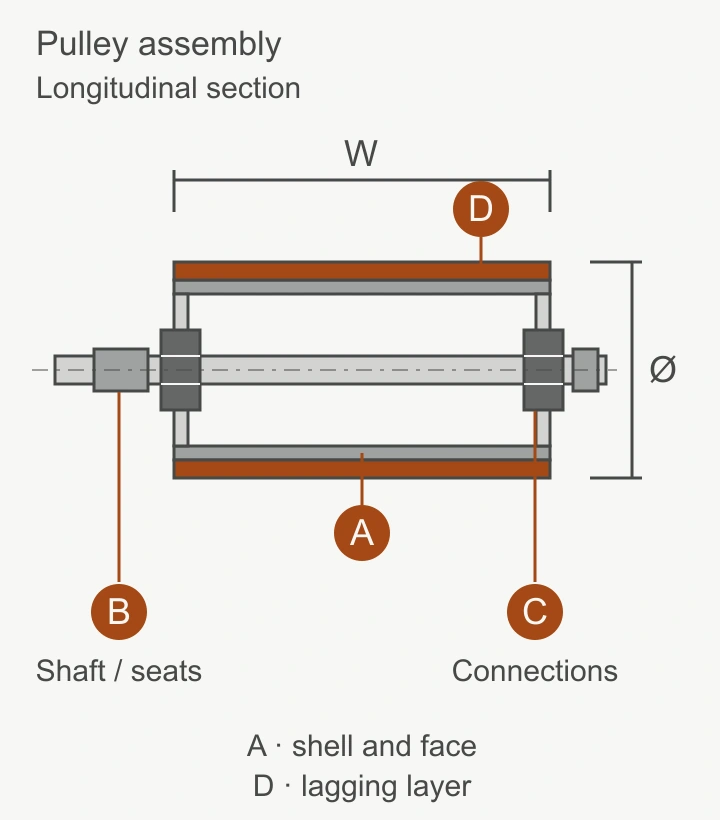
W: face width. Ø: finished outside diameter, including lagging where fitted. Use the assembly drawing for the actual construction.
Open diagram ↗- A · Shell and face
- Give the face width, shell diameter and wall specification. State whether the outside diameter is measured on bare steel or over finished lagging; also identify any crown on the drawing.
- B · Shaft and bearing seats
- Include both shaft extensions, bearing-seat diameters and lengths, shoulders and locating features. For a drive pulley, identify the drive end.
- C · Connections
- Show the hub or locking arrangement and any drive connection, where fitted. Include keyways, threads and retainers where used; do not assume the supplier can recover their dimensions from a general photograph.
- D · Lagging layer
- Give the specified material, finished thickness, pattern and edge detail. For re-lagging, distinguish the existing condition from the required finished size.
Send the drawing revision and units with the measurements. Label dimensions taken from a worn pulley as measured values, not design dimensions. If an interface is still unknown, name the part that needs checking rather than filling in an estimated tolerance.
A groove pattern is not a complete lagging specification
Lagging is the layer fitted to the pulley shell beneath the belt. On a drive pulley, that contact surface is part of the traction system. A photograph of diamond grooves tells you what the surface looks like; it does not identify the compound, thickness, bonding system or suitability for your duty.
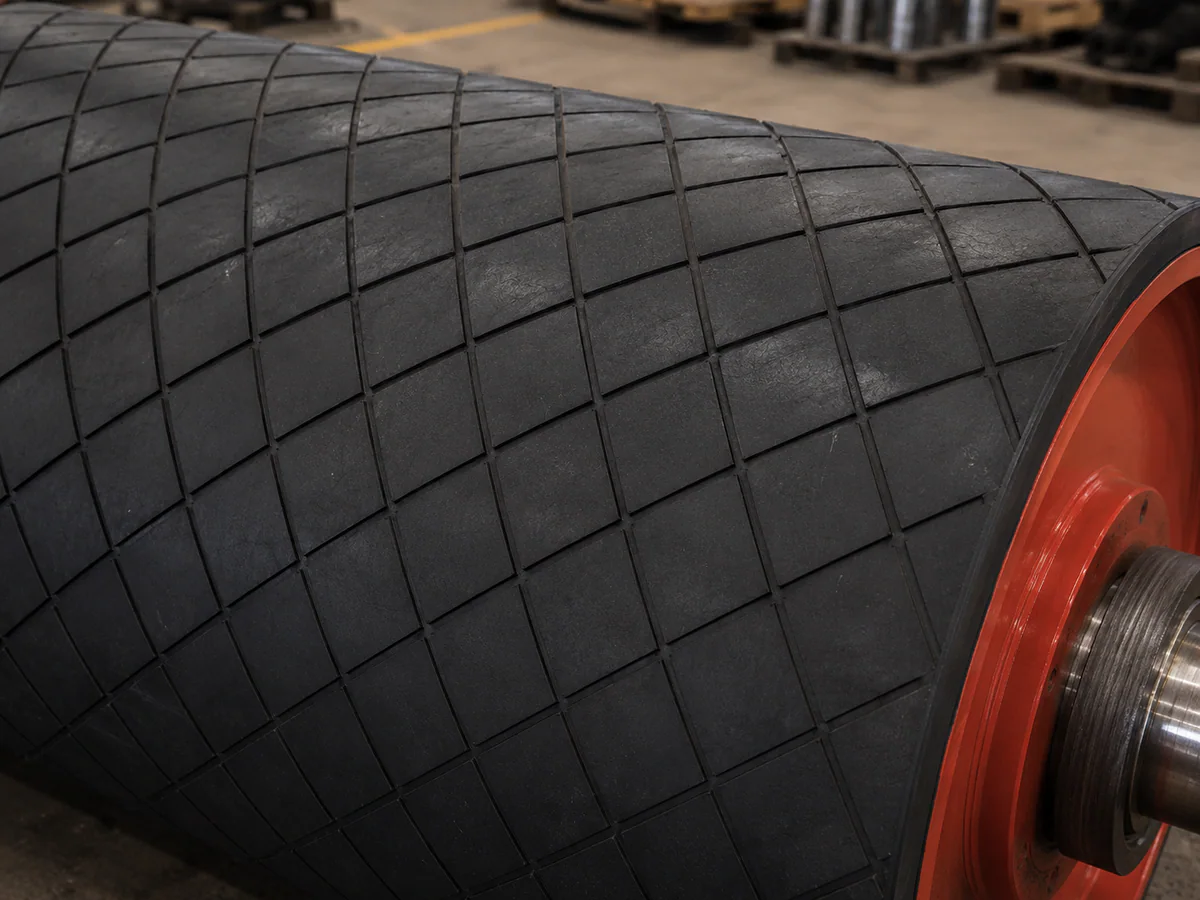
Describe the surface beyond its appearance
Record the belt-contact condition, moisture, contamination and temperature, then add the specified compound, thickness and groove layout. Include the belt direction where the pattern has a required orientation.
Belt-drive design depends on the contact materials, belt speed and wrap angle—the angle through which the belt contacts the pulley. NPTEL’s flat-belt design lesson (PDF) explains these relationships. Changing the surface alone does not establish that a drive has enough traction for its duty.
If a project calls for ceramic lagging, send that requirement explicitly. Do not accept “lagged” as confirmation of the material, or substitute ceramic for rubber without reviewing the belt and operating conditions. Ceramic lagging availability must be confirmed separately before it is included in a quotation.
Where fire resistance, antistatic behaviour or another specified property is required, identify the applicable requirement and the evidence needed for the quoted system. Neither the groove pattern nor a general company certificate establishes that property.
Motor power is only one input
A motor rating does not define the load on a pulley assembly. With the same power, a different running speed changes the torque involved; belt tensions and their directions also matter to the shaft and support arrangement. Send the operating inputs already established for the conveyor, not a new set of estimates made to complete an enquiry.
- Belt width and specification, belt speed, pulley speed and drive power or torque, where known.
- Belt tensions and loading directions, with the source of those values or the relevant design document.
- Starting, stopping, reversing and duty information that the equipment designer has specified.
- Bearing/support arrangement, drive connection, surrounding clearance and any defined radial or axial loads.
Keep nameplate data, design values and operating measurements distinct. If load information is missing, include the conveyor reference and ask which inputs must be resolved before the assembly can be specified. Do not treat the nameplate alone as a shaft-design approval.
Describe when it slips before choosing new lagging
Send existing operating and maintenance records showing when slip occurs, what was observed and what changed. Keep the reported event separate from a suspected cause.
- When it happens
- Starting, steady running, a particular load, a change in weather or after recent maintenance. Note whether the problem is new or recurring.
- What was observed
- The location and circumstances of the reported slip, and any recorded belt or pulley speed. Separate observations from a suspected cause.
- Surface condition
- Available inspection notes or safely obtained photos showing moisture, contamination, wear, damage or separation of the lagging.
- What changed
- Belt, splice, pulley or lagging replacement; changes to loading or drive/take-up equipment; previous inspection findings.
Use existing records or observations from an authorised safe location. Physical inspection must follow the site’s isolation and lockout procedure, including stored energy. Do not remove guards, reach toward a running belt or adjust tension to gather information for an RFQ.
The equipment’s responsible engineer should decide whether the issue calls for a lagging change, another repair or further investigation. We can review the pulley and surface requirements once that scope is clear.
Make the quotation clear about what is included
Send the drawing or equipment reference, quantity and the parts you want supplied. An incomplete set of information is enough to start the discussion if the missing items are identified.
| Item | State what you need |
|---|---|
| Pulley assembly | Complete assembly or named components; identify any existing parts to be reused. |
| Lagging | Included, excluded or awaiting review; material, thickness, pattern and finished diameter. |
| Bearings and housings | Supplied and fitted, supplied loose, or excluded; identify the required references. |
| Inspection and records | Critical dimensions, runout, balance or weld/lagging checks where specified, with methods and acceptance criteria. |
| Delivery condition | Assembly state, exposed-surface protection, packing, quantity and destination. |
For re-lagging or rebuild enquiries, identify the existing assembly and its condition. Do not assume removal of old lagging, shell repair or reuse of bearings is included in a new-pulley quotation.
A short checklist for the drawing package
Use the text file to collect the information above. Leave unknown items marked as unknown; it is a preparation aid, not another required form.
Download pulley enquiry checklist (TXT)Our pulley production includes drive and bend assemblies with locking-assembly or welded constructions. The pulley manufacturing page sets out the scope and inspection inputs. Share the project specification so we can confirm the proposed supply, open technical questions and quotation requirements.