
Undercarriage buying guide
Excavator Track Shoes: Width, Grouser and Fit Selection
A replacement track shoe needs to match both the undercarriage and the ground it works on. Start with the machine’s approved shoe options, then check width, grouser profile and mounting dimensions. A wider plate is not automatically a better choice.
Track shoe, rubber pad or complete track?
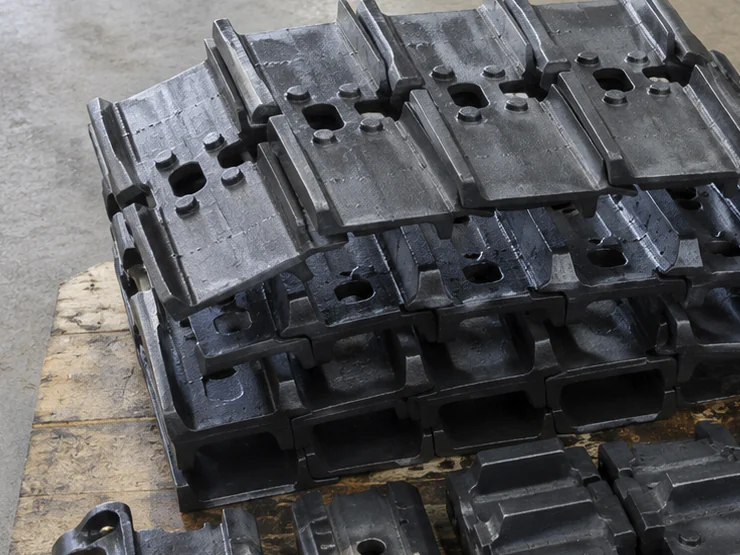
A steel track shoe is the ground-contact plate attached to the track links on a conventional bolted-shoe undercarriage. The raised ribs are called grousers. They help the track engage the ground.
“Track pad” is less precise. It may mean a steel shoe, a rubber pad fitted over a steel shoe, or a different rubber-faced assembly. A continuous rubber track is another product altogether. These parts have different mounting arrangements and cannot be ordered from the same measurements.
If an enquiry just says “excavator pads,” include a photograph of the complete track and one of the part’s underside. For the steel plates discussed here, see our steel track shoes and pads. Adding a rubber pad also changes the assembly; check the pad system and machine requirements separately.
Why wider track shoes are not always better
On soft ground, extra width can help reduce sinkage by spreading the load over a larger area. That benefit assumes a comparable machine load and track contact length. A ground-pressure figure alone does not describe how the machine will behave in deep mud, on loose fill or across buried rock.
Soft ground: check support
Describe the soil, wet conditions, loaded machine configuration and how much traveling the job involves. Review the approved shoe widths for that duty. “It sometimes sinks” is useful context, but is not enough to specify a wider replacement.
Hard, uneven ground: check loading
A wide shoe can contact a rock at its outer edge while the rest of the plate is unsupported. That loading can bend the shoe and transmit stress into the undercarriage. Extra width also deserves review where frequent turns are required.
A practical starting point is the narrowest machine-approved shoe that gives adequate support for the job. Before changing width, check the machine’s permitted configuration and clearances with the responsible service or engineering team. Width is not a substitute for the operating limits in the machine manual.
Single, double or triple grouser?
Grouser count describes the number of raised ribs across the shoe. It does not define the complete section. Two shoes with three grousers can have different rib heights, plate thicknesses and mounting patterns.
| Profile | What to identify | Selection consideration |
|---|---|---|
| Single grouser | One prominent transverse rib. | Offers strong ground penetration where the machine and ground conditions call for it. Turning resistance is part of the trade-off. |
| Double grouser | Two transverse ribs. | Generally trades some of a single-grouser shoe’s penetration and traction for easier turning. Check rib height, spacing and the machine’s approved configuration before choosing it. |
| Triple grouser | Three transverse ribs. | Common on excavators. Compared with a single-grouser design, it generally favors easier turning over deep penetration. |
Aggressive penetration is not useful in every application. On a hard surface where the ribs cannot penetrate, the contact and turning behavior differ from work in soil. Compare the original profile, the ground conditions and the approved alternatives together; do not select a shoe simply by counting ribs.
Use the original drawing or an unworn, verified reference for grouser height. A worn sample is valuable for showing where material has been lost, but copying its remaining height would reproduce the wear.
Check the mounting fit before comparing prices
The machine model helps identify the application. The serial range, undercarriage configuration and verified part reference narrow it down further. For a drawing-led replacement, the mounting details still need to agree with the actual assembly.
- Shoe outline
- Overall width across the machine, dimension in the direction of travel, plate thickness and grouser height. Mark the travel direction on the drawing.
- Hole pattern
- Hole count, diameter and center-to-center distances in both directions. Identify the datum and any offset or asymmetry.
- Bolt seating
- The specified bolt-head seat, recess or countersink where present, plus the matching bolt and nut details. A hole that accepts the bolt is only one part of the fit.
- Contact and clearance
- The mounting faces against the links, edge clearances and any interference with adjacent shoes or the machine. Confirm these against the approved assembly.
Track pitch and shoe bolt-hole spacing are different measurements. Track pitch describes the spacing between successive track-pin centers. The shoe drawing must identify its own mounting-hole pattern. A shared track pitch alone does not establish that two shoes are interchangeable.
Photograph the top, underside and side profile, with a scale visible where useful. Mark any worn or elongated holes rather than using them as the nominal dimensions. If the drawing and the sample disagree, resolve that difference before approving manufacture.
Bolts, nuts, tightening procedures and inspection after installation must follow the requirements for the actual assembly. There is no universal torque setting for all track shoes.
Specify material condition, not just hardness
Abrasive soil gradually removes material. Rock contact can also cause local deformation or cracking. When ordering a replacement, describe what happened to the previous shoes: worn ribs, a bent plate, cracks or movement around the mounting holes call for different questions.
A hardness value is useful only with a test method, test location and acceptance requirement. It does not, by itself, establish toughness, through-section properties or service life. Set the steel grade, heat-treatment condition and required checks together, using the drawing or agreed specification.
ROCKVANTA’s published material test reports show results for the samples identified in those reports. For a new order, agree which material and inspection records must accompany that batch. A previous sample result does not certify a different shoe or production lot.
Where wear is uneven, review the rest of the track system as well. Our guide to track rollers, carrier rollers and idlers helps identify those components before a replacement enquiry.
Questions that come up on replacement orders
Can I change width without changing the track chain?
Some machines have approved shoe-width options for a given undercarriage. That does not make every wider shoe suitable. Confirm the exact chain and shoe combination, bolt pattern, clearances and intended duty before ordering.
Is one broken shoe a reason to replace the whole set?
The purchase quantity should follow an inspection of the remaining shoes, fasteners and supporting components. Record any cracking, loose hardware or repeated damage in the same area. A photograph of one broken plate cannot establish whether a single replacement will address the problem.
Does a harder shoe last longer?
Hardness alone cannot predict that. Wear depends on the ground, loading, material condition and operation, while the shoe must also withstand the required mechanical loads. Compare an agreed material specification and inspection plan rather than choosing the highest advertised hardness.
What to send for a track shoe quotation
A drawing and a few clear photographs are usually the best starting point. Include the details you have; flag uncertain measurements so they can be reviewed.
- Machine and reference: model, relevant serial information, undercarriage configuration and part number, if verified.
- Shoe geometry: width, section, grouser profile and mounting dimensions, with the drawing revision.
- Working conditions: ground type, traveling and turning duty, plus photographs of wear or damage on the old shoes.
- Order scope: quantity of individual shoes, whether bolts and nuts are required, and whether delivery is loose or assembled.
- Acceptance and delivery: material and inspection requirements, destination and required delivery date.
Check that quotations cover the same drawing revision, shoe quantity, hardware and inspection records. A price for bare shoes cannot be compared directly with a price for shoes supplied with fasteners or assembled onto a track chain.