
Undercarriage buying guide
Track Rollers vs Carrier Rollers vs Idlers
Track rollers carry the machine along the lower track run. Carrier rollers support the upper return run. Idlers guide the track around an end of the loop. That tells you which component you are looking at—but not which replacement will fit.
Before comparing prices, check three things: where the part sits, how it connects to the machine and what the supplier is actually quoting.
Start with its position on the track
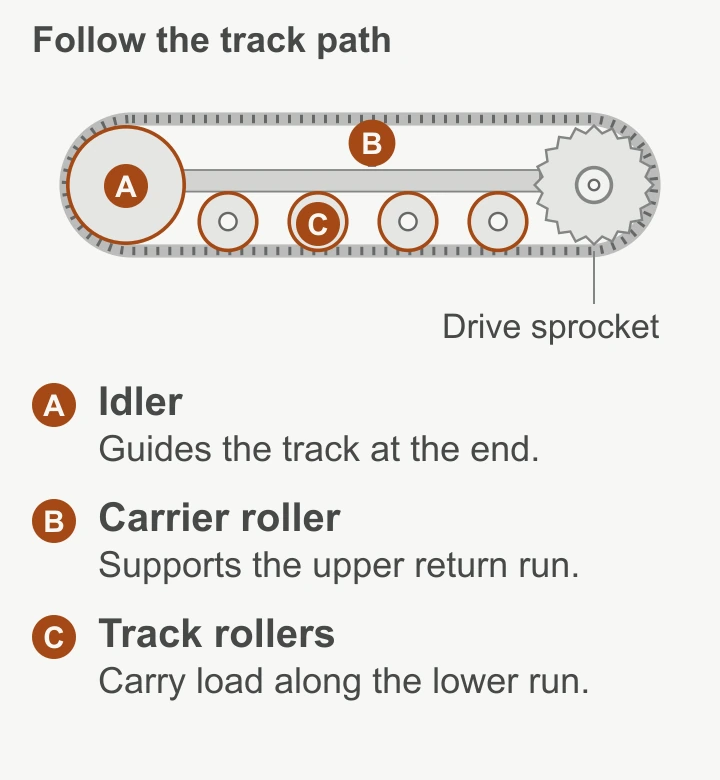
Follow the track path to identify the part. Roller count and idler arrangement vary with the machine.
Open diagram ↗A photograph of a loose wheel loses useful information. Start with the installed position, then match it to a parts drawing or a readable reference number. Do not assume that the idler is always at the front: track layouts differ.
The drive sprocket is another component. Its teeth engage the track; it is not an idler, even when both parts sit at the ends of the track loop.
What changes between the three components?
| Component | Position | Job and other names | What to compare |
|---|---|---|---|
| Track roller | Under the track frame, along the lower track run. | Carries machine load onto the track. Also called a bottom roller or lower roller. | Tread and flange profile; mounting faces and bolt holes; shaft and retention details. |
| Carrier roller | Above the track frame, supporting the upper return run where fitted. | Supports the returning track chain. Also called a top roller or upper roller. | Shaft projection and retention; support bracket; running profile against the track. |
| Idler | At a turning end of the track loop; the arrangement depends on the machine. | Guides the track around the end of its path. On many machines it works with the track-adjusting mechanism. | Wheel profile; shaft ends and support blocks; guide and adjuster interfaces. |
Single-flange and double-flange describe roller geometry, not a universal classification for every undercarriage. Compare the actual running profile and its position in the track system. Do not substitute a roller just because its name or overall shape sounds right.
Searching for rollers that support a conveyor belt? Those belong to a different product family: conveyor rollers and idlers.
A matching diameter does not mean a matching part
Outside diameter is easy to compare, so it often becomes the first number in an enquiry. It is not enough on its own. Two wheels with similar diameters can have different running widths, flange profiles or mounting arrangements.
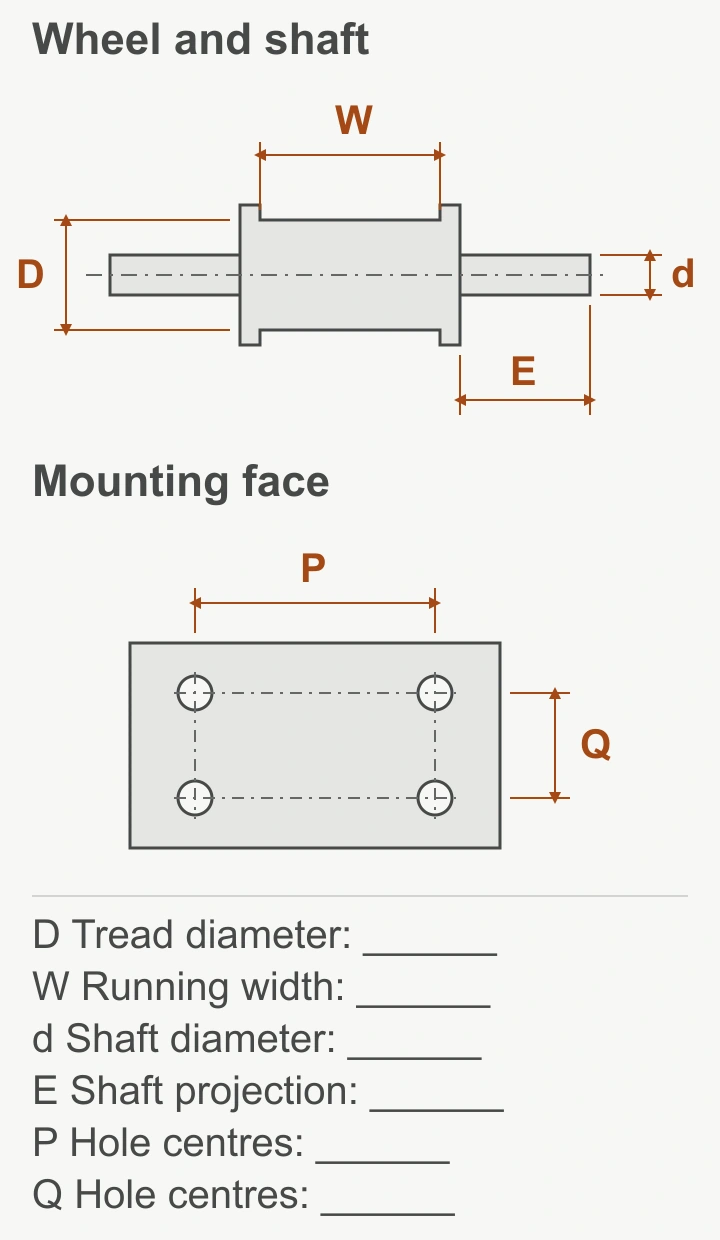
Use these labels on your drawing or photographs and state the units. Record each shaft end and the actual hole pattern separately; leave uncertain dimensions blank.
Open template ↗Running surface
Mark the tread diameter, running width and flange profile on a side and end view.
A similar outside diameter can hide a different contact profile against the track link.
Mounting
Show the mounting faces, hole pattern, bracket shape and orientation.
A roller can look right on a bench but fail to line up with the frame.
Shaft and retention
Show shaft diameter, end shape, projection and the way it is retained.
Different shaft ends or support blocks change how the assembly fits.
Mating parts
Identify the track-link reference and any reused brackets or support blocks.
A replacement needs to work with the parts that remain on the machine.
Use a controlled drawing or a confirmed part reference as the basis for manufacture. Measurements from a worn roller help identify it, but they do not establish the original size or the required tolerance. Flag uncertainty instead of filling the gap with a guessed number.
The machine model is useful background. Add the serial number or applicable parts-book reference where available; model variants and previous changes to the undercarriage can leave more than one possible configuration.
Wheel body or complete assembly?
“One idler” can mean a wheel body, a wheel with a shaft, or a larger assembled unit. A lower price tells you very little until the included parts are clear.
Example quotation descriptions
Wheel body only
Machined wheel body to the agreed drawing. Shaft, bearings or bushings, seals and mounting parts excluded.
Wheel and shaft assembly
Wheel, shaft, specified bearings or bushings, and seals assembled. Mounting brackets and track adjuster excluded.
These examples are not fixed supply packages. Ask each supplier to list the included parts so you can compare the same scope.
- Included parts: wheel body, shaft, bearings or bushings, seals, support blocks, brackets and fasteners, as applicable.
- Delivery condition: loose parts or assembled; any agreed lubrication, coating and packing.
- Acceptance: required dimensional records and any agreed hardness, runout, rotation or seal checks.
If you intend to reuse an old bracket or shaft, identify it before the quotation is finalised. The supplier needs to review that interface too.
No part number? Start with these photographs
A missing part number does not stop the enquiry. A small set of labelled photographs is more useful than several close-ups with no indication of where the part belongs.
Installed position
Take a side view of the whole track and mark the component you need. Say which side of the machine it is on.
Both ends and the mounting
Show the shaft ends, brackets, support blocks and mounting holes that are safely visible. Include a wider view so the orientation is clear.
Markings and running surfaces
Photograph readable part numbers or cast markings, then the tread and flanges. Identify any damage or wear rather than measuring it as if it were new.
Drawing or measurement sheet
Add the drawing revision if available. Otherwise label each measurement on a photograph, state the unit and flag dimensions you cannot verify.
Take photographs only when the machine is safely stopped and isolated according to its operating procedures. Do not remove guards, release track tension or dismantle an assembly just to complete this checklist.
Include abrasive material, persistent mud, water exposure, unusual temperatures or recurring seal problems in your enquiry. Ask the supplier to review the seal arrangement, lubrication and inspection requirements for those conditions.
Give the supplier something they can check
ROCKVANTA reviews track rollers, carrier rollers and idlers against drawings, samples and project requirements. The review covers the wheel type, mating interfaces and supply scope before the production and inspection requirements are agreed.
For your first message, include whichever of these you already have:
- The machine and installed position, plus a readable part reference or drawing.
- The quantity and whether you need a wheel body, individual components or an assembly.
- Photographs of the mounting and running profile, with any uncertain dimensions clearly marked.
You do not need a finished specification to start. Send the available reference and say what is missing.