
Screening media guide
Screen Media Selection: Woven Wire, Polyurethane and Rubber
Two screens marked with the same aperture can give different results. The space between openings, the way the media is held and the material arriving on the deck all matter. Start with the separation you need, then compare the construction.
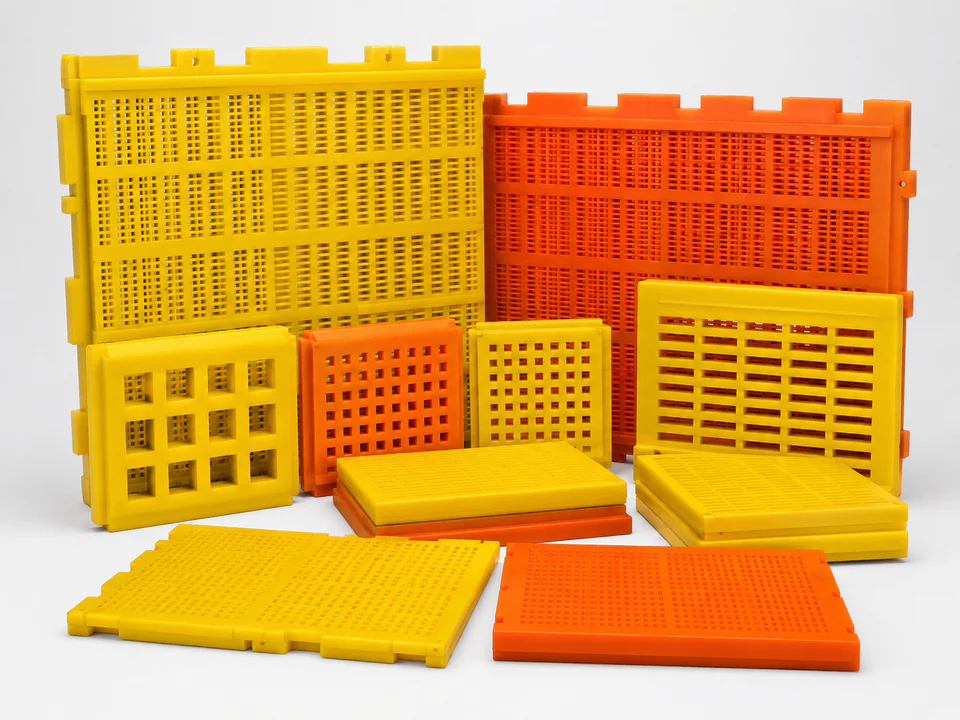
Start with the product you need to separate
Screen media is the surface through which particles are separated: woven wire cloth, perforated plate, polyurethane panels, rubber panels and other specialised constructions. It is one part of the screening system, not the complete machine.
Before choosing a material, write down the required product size distribution and acceptable misplaced material. A nominal opening is a geometric dimension; the achieved separation also depends on particle shape, the proportion close to the opening size, feed presentation and the screen’s operating conditions.
Give the supplier a feed analysis, not only the largest lump size. Include the expected rate, moisture variation, clay or sticky fines, and whether water is deliberately added. An evenly wetted wash duty and a damp, sticky feed can present quite different problems.
If the enquiry includes the machine itself, separate that scope from the replacement media. See our screening-machine page for the equipment information needed alongside the panel specification.
Compare the construction, not just the material name
| Media | Reason to consider it | What to check |
|---|---|---|
| Woven wire | A useful starting point when open area is a priority and the feed is reasonably free-flowing. | Wire diameter affects both the available opening area and resistance to wear or damage. Check wire grade, weave, aperture stability and the tensioning arrangement. |
| Polyurethane | Often considered for abrasive duties, including wet screening, with a panel design suited to the separation. | Compare actual aperture geometry, rib width, thickness and fixing details. Compound, temperature and chemical exposure matter; “PU” alone does not define performance. |
| Rubber | Often considered where coarse feed and impact make a resilient screening surface useful. | Check the impact duty, panel support and usable open area. A thick panel may protect the deck but leave less room for openings. Suitability for wet or dry service depends on the construction. |
These are starting points, not a ranking. A thin wire cloth and a thick modular panel differ in more than material. Compare the proposed opening pattern, support and fixing method before attributing a change in throughput or life to the compound alone.
Keep purchase price and operating cost separate. Record usable tonnes processed, change-out labour, stoppage time and whether the required product grading was maintained. A panel that lasts longer but restricts the required output may not be the lower-cost option.
For polyurethane panels or steel screen media, send the drawing or reference sample. State the required material and fixing arrangement; mark any proposed alternative separately so it can be reviewed against the same duty.
The same hole size can leave very different open areas
Ask how an open-area percentage was calculated. A value for the perforated region excludes different things from a value for the entire panel or installed deck. Solid borders, support ribs, fixings and blank sections can reduce the area available to pass material.
A simple square-mesh example
For an ideal repeating square mesh, projected open area is [a ÷ (a + d)]² × 100%, where a is the clear opening and d is the wire diameter, both in the same units.
- 10 mm opening · 3 mm wire
- (10 ÷ 13)² × 100 ≈ 59%
- 10 mm opening · 5 mm wire
- (10 ÷ 15)² × 100 ≈ 44%
These are geometric examples, not product ratings. They exclude borders, supports, blockage and wear. They do not predict a proportional change in machine capacity, and the formula is not a substitute for a moulded panel’s drawing.
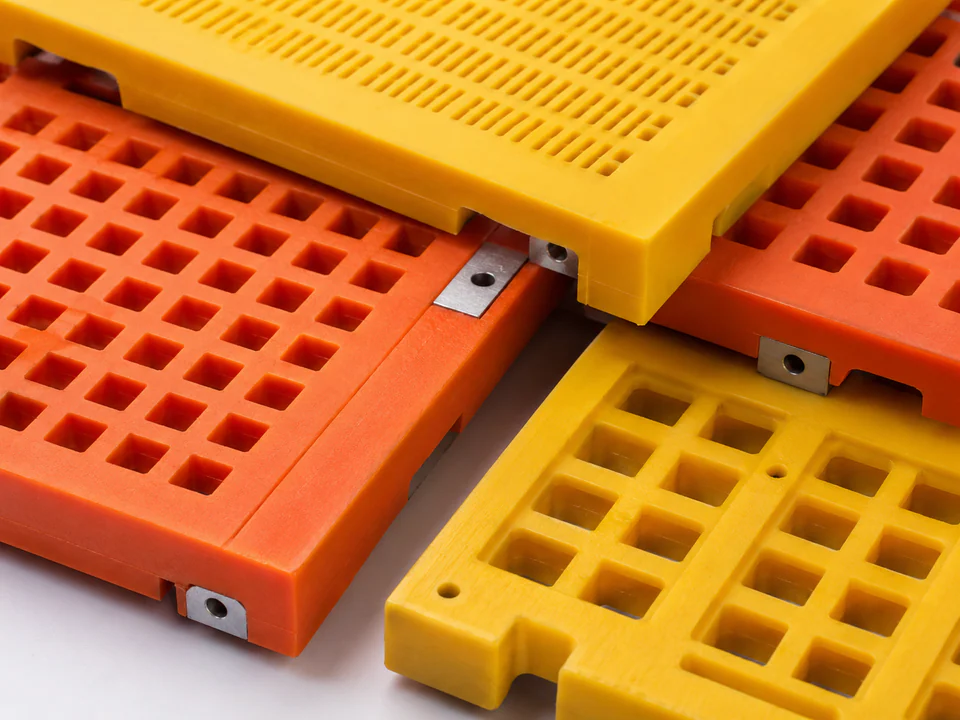
Keep shape and orientation on the drawing
A square opening and a slot with the same narrow dimension are not equivalent. Show both slot dimensions and its direction relative to the feed. Check the effect on elongated particles and the required product grading.
For a tapered opening, identify the measuring face and how the opening changes through the panel thickness. A single top-view dimension can leave that geometry unresolved.
Work out what is blocking the openings
- Pegging
- Individual particles lodge in openings. Look for near-size pieces wedged in the holes rather than a continuous coating across the surface.
- Blinding
- Fine or sticky material covers the screening surface and closes the openings. Moisture and adhering fines can be part of the problem.
A photograph of the affected area is more useful than a request for an “anti-blocking” screen. Record where the blockage begins, whether it changes as the feed becomes wetter, and what the blocked material looks like.
Flexible media or a different aperture profile may help release lodged particles, but changing material alone does not resolve every cause. Feed distribution, bed depth and the operating setup need review as well. Any changes to screen settings, water addition or media mass should be checked against the equipment and process requirements.
Inspect or measure the deck only under the site’s safe shutdown and isolation procedure. Do not reach into an operating screen to diagnose the pattern.
A panel must fit the supporting deck
Tensioned media: record the tension direction, hook or edge profile, support-bar spacing and the deck contour. Identify the clamps and any support protection. Overall length and width alone do not define the installed fit.
Modular media: show the locating rails, pins, locking features or other retention system, together with the adjoining panels. Nominally similar modules are not necessarily interchangeable. Include the edge, transition and blank panels in the deck map.
Replacing a wire-cloth arrangement with modular panels may involve a different support system and media mass. Treat it as a proposed deck conversion to be reviewed, not a drop-in material substitution. Send the existing and proposed arrangements together so the responsible equipment specialist can assess the change.
Measure the replacement without copying the damage
- Identify the position
- Mark the machine, deck, feed direction and panel location. Record any blank, impact or transition sections separately.
- Measure the complete part
- Record length, width, thickness, edge profile and locating features. Include underside views and fixing centres, not just a photograph of the top face.
- Separate design from wear
- Compare worn areas with an unused spare or controlled drawing. Enlarged holes, stretched hooks and damaged edges should not become the new nominal dimensions.
- Record the operating result
- Keep the feed and product size analyses, moisture condition, operating hours and photographs of blockage or wear. Identify what you want the replacement to improve.
When testing a different construction, agree what will be compared. Use recorded feed conditions, product grading, usable output, blockage, wear and change-out time. A trial under lighter duty does not establish the same improvement under the original conditions.
Send a drawing package that can be quoted
You can start with the current drawing, a sample or a clear set of photographs. Mark what is known and what needs checking; do not fill missing fields with guessed dimensions.
- Duty
- Material, feed-size distribution, top size, near-size fraction, throughput, moisture or wash-water condition, operating temperature, chemical exposure, and required product separation.
- Geometry
- Opening shape, dimensions and orientation; wire diameter or panel thickness; open-area definition; overall size and deck position.
- Fit
- Deck drawing, supports, rails, hooks, clamps or locking features, adjoining panels and quantities by position.
- Acceptance
- Required material, aperture and dimensional checks, trial-fit scope, identification, documents, destination and delivery date.
Ask each supplier to identify the offered material and construction, drawing revision, included fixings and any assumptions. Keep these details with the quotation so price comparisons refer to the same supplied item. Our quality and inspection page explains how project checks and records are agreed.