
Screening equipment guide
Vibrating Screens: Working Principles and Selection Inputs
A screen can keep material moving and still miss the required separation. Before comparing machines, define what is arriving at the deck and what must leave each outlet. Deck dimensions and motor power are only part of the decision.
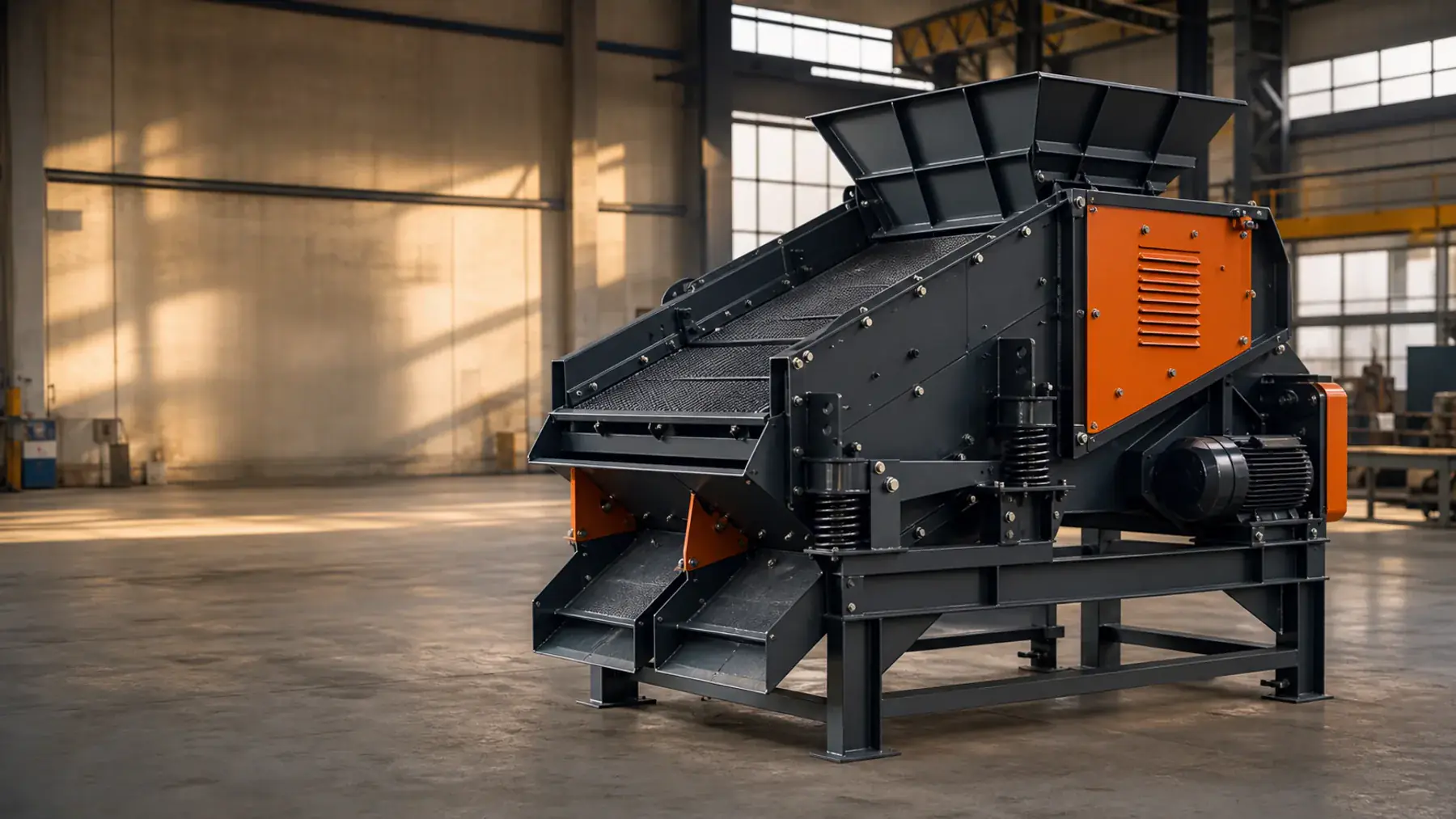
How does a vibrating screen separate material?
A vibrating screen separates bulk material mainly by particle size. Motion moves the feed across a surface containing openings. Smaller particles that reach suitable openings can pass through; material retained on the deck travels towards its discharge. Screening sorts the feed. It is not a substitute for crushing oversize lumps.
On many conventional screens, rotating unbalanced masses in an exciter or vibrating motor generate the motion. Depending on the drive arrangement, the deck follows a circular, linear or elliptical path. The drive arrangement and settings belong to the machine design, not to the aperture specification.
For a particle to pass, it first has to reach the screening surface. Movement helps rearrange the bed so finer particles can work down between larger ones. Each contact offers another opportunity to pass. A deep or uneven bed can carry undersize material to the oversize outlet before it has enough contact with the deck.
A single deck can divide the feed into two streams. A two-deck arrangement can produce three size fractions when the openings and discharge paths are arranged for that duty. More decks do not automatically mean more capacity: each lower deck receives a different feed and needs its own check.
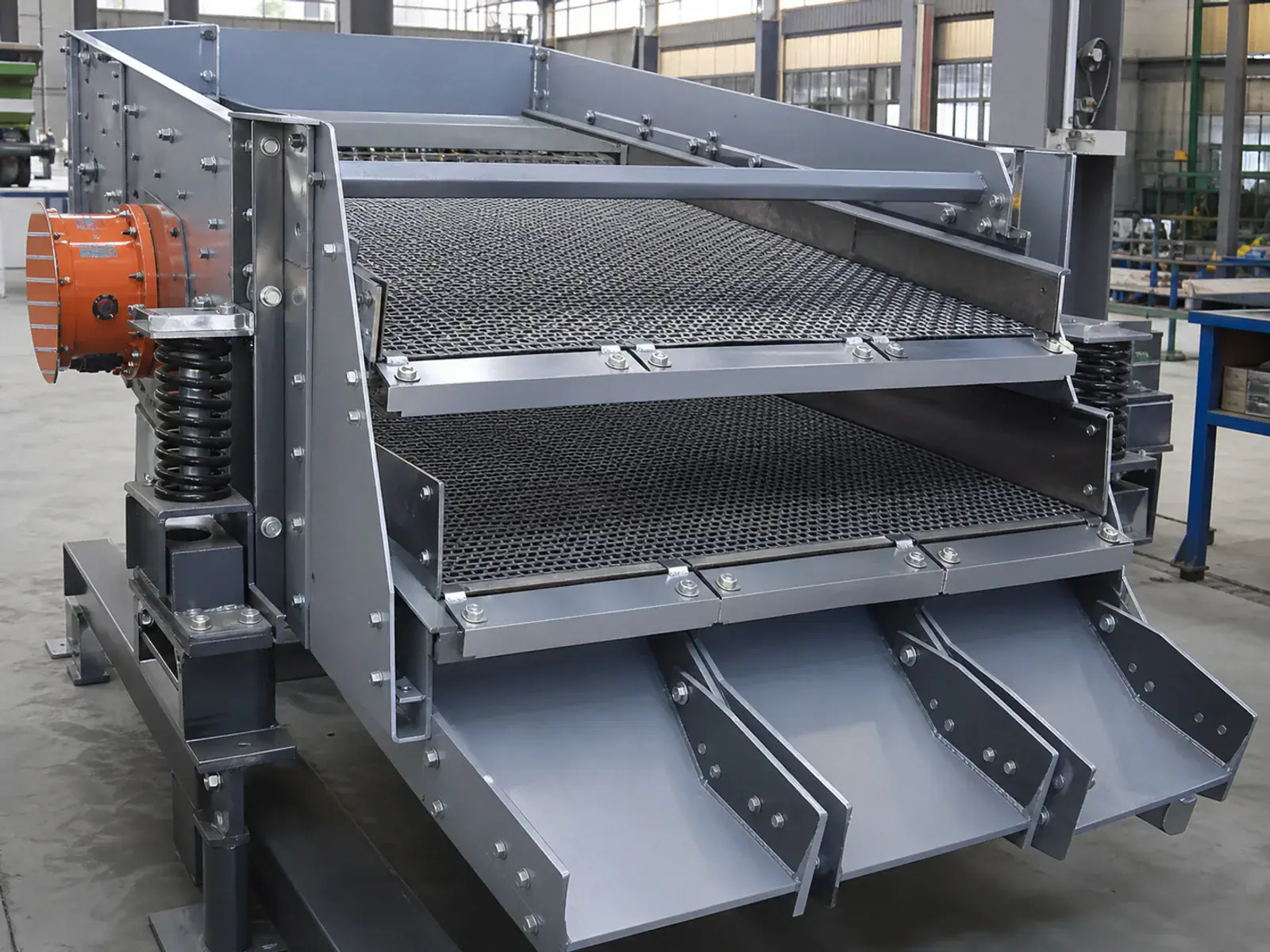
The opening size is not a guarantee of the final product grading. Particle shape, near-size material, moisture, bed depth and motion all affect the separation. Specify the acceptable product, then review the proposed aperture and operating arrangement against it.
Start with a feed sample and a product requirement
“Screen soil” or “separate aggregate” is enough to begin a conversation, but not enough to select a machine. A short duty sheet gives the supplier something testable to work from.
- Feed grading
- Supply a size analysis, the largest expected lump and the fraction close to the proposed opening. Two feeds with the same top size can place very different demands on a screen.
- Material condition
- Name the material and give measured bulk density where available. Include moisture range, clay or sticky fines, particle shape, temperature and any seasonal change. Mark estimates as estimates.
- How it arrives
- Describe conveyor-fed, controlled hopper-fed or intermittent loader charging. Give the normal and peak rate, the units and whether the rate is measured or estimated. Include the loading height.
- Required products
- State the size range and acceptable misplaced material for each outlet. Say which fraction is sold, sent to another process or rejected. Include the required output rate for the usable product.
If the material changes during the year, describe the difficult condition as well as the usual one. Keep the sample labelled with its source, date and moisture condition. A dry sample taken from the top of a stockpile may not represent the damp material fed after rain.
A capacity figure needs a basis
First ask what the number measures: feed entering the machine, total discharge or usable product meeting the agreed grading. A high feed rate is not useful if too much undersize leaves with the reject.
Keep mass and volume units separate. A figure in tonnes per hour cannot be compared directly with cubic metres per hour without the relevant bulk density. Also state whether mass is on a wet or dry basis and whether the rate is an average or a short peak.
If a quotation uses “tons per hour”, check whether it means metric tonnes or US short tons. Write the unit in full before comparing figures.
The question behind “tonnes per hour”
What feed grading, moisture, bulk density, aperture and product requirement were used? Was the quoted result measured with representative material, calculated, or taken from a different application?
Screen area is only one input. Usable open area, feed distribution, the amount of near-size material, bed depth and time on the deck also matter. Ask for the assumptions behind a recommendation. If representative trials are needed, agree the sample, test conditions and acceptance method before treating a result as a production commitment.
Why do openings become blocked?
Blinding: material sticks across the opening
Damp fines or sticky material can coat the surface and cover openings. Record the moisture, clay content, affected area and how quickly the blockage develops. Check whether the problem follows a change in feed condition or loading.
Pegging: particles wedge in the opening
Near-size or awkwardly shaped particles can lodge in an aperture. Photograph the trapped particles and record the opening shape, size and orientation. Simply increasing the opening may clear some material but change the product grading.
Media construction, feed preparation and an appropriate cleaning arrangement may form part of the response. They need review against the machine and duty. Do not change drive speed, stroke, deck angle or supports without the equipment supplier’s engineering review. Stop and isolate the equipment before close inspection or measurement.
For the differences between wire, polyurethane and rubber surfaces, see our screen-media selection guide. Replacing the surface alone will not resolve every feeding or machine problem.
Will the proposed machine fit the operation?
A machine that fits the floor plan can still leave no room to load it, remove the product or change a screen panel. Mark these interfaces on a general arrangement drawing.
- Feed and discharge
- Hopper access, loading method and height, largest lump, feed distribution, outlet positions and the clearance needed for bins or downstream conveyors.
- Support and access
- Available footprint, foundation or supporting steelwork, maintenance space, safe access and the route for replacing media or removing the drive. Request the proposed static and dynamic support loads for engineering review.
- Power and services
- Supply voltage, frequency and phase, controls interface and site restrictions. If wet screening is proposed, include water supply, drainage and handling of the wet products; do not assume washing is included.
- Environment
- Dust, weather exposure, corrosion, operating hours, noise constraints and transport limits. Note any site-specific guarding or isolation requirements for the agreed design.
For an existing installation, send photographs of the approach, feed point, supports and outlets as well as the machine. Dimensions should come from a controlled drawing or a safe site survey, not from scaling a photograph.
Are you buying a machine, a plant or replacement media?
These enquiries can share the same material brief, but the supply boundaries differ. Name the scope before comparing prices.
- A screening machine: define the deck arrangement, drive, frame, hopper and discharge components required. Mark which feeding and conveying equipment already exists.
- A screening plant: include the integrated feed and conveying system, relocation or transport needs, site interfaces and responsibility for installation. See mobile and portable screening plants.
- Replacement media: identify the machine and deck, opening geometry, panel or cloth dimensions, supports and fixing method. See screen media and polyurethane panels.
ROCKVANTA reviews screening-machine enquiries against drawings, specifications and project requirements. If you use a brochure model as a starting reference, identify the exact model and list the changes required. Do not transfer a configuration or output figure from another model.
Send the duty first; mark what is still unknown
Start with the material, desired separation and the space available. Add a feed analysis, photographs, site sketch or reference drawing where you have them. The checklist below keeps the missing information visible without requiring a complete machine specification at the first enquiry.
Ask the quotation to state the offered arrangement, included equipment, exclusions, performance assumptions and records to be supplied. Agree how the separation will be checked with representative feed. A no-load running check does not establish throughput or product grading under load.
Keep the agreed duty and drawing revision with the order. Our quality and inspection page explains how project checks and records are defined.